Artist is earning the biggest return with the least effort
A few days ago, I came across this interesting post with a nice picture on LinkedIn. Due to the uncommon nature of the picture and attention-grabbing title, it immediately caught my eye.
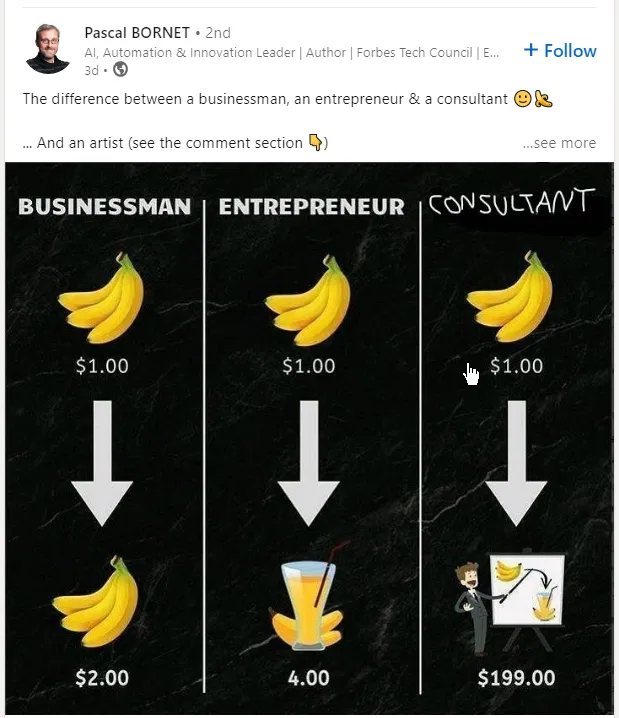
In the era of social media, our attention span is very low. And we have major confirmation bias. (Selectively giving attention to things that confirm our constructs). We rarely have time to listen to others’ views. And due to lack of free time, our minds always try to conclude things fast.
I’ve seen many similar posts. But this time I paid attention to my thought process. Though I understood it was a “Funny Post” a thought immediately crossed my mind. “The consultants are earning way more money than what they actually should. And the poor businessman and the entrepreneur who actually does the work earns way less than what they deserve”.
I would have happily scrolled through to other posts, with the conclusion that “Consultancy is an extremely rewarding profession with more pay and less work”. But this post specifically asked me to read the comments to see the same representation for an Artist. And a comment had the below.
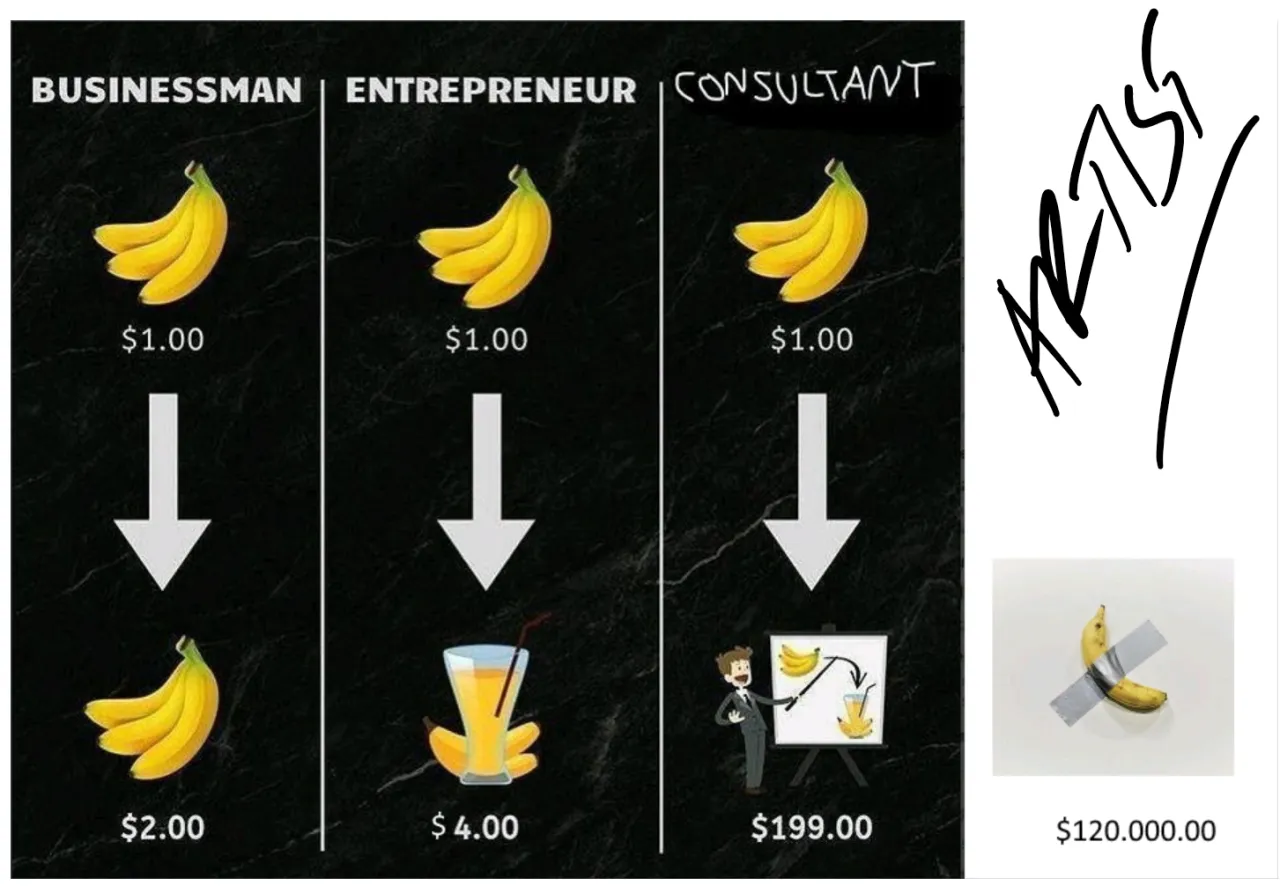
And then another thought crossed my mind. “Yes. Artists earn an unreasonable amount of money for a way lesser effort and the reward is instant. And sometimes it doesn’t make any sense also.” and I remembered the below photograph by Andreas Gursky that was sold for $4.3 million, not so long ago, on November 8, 2011.

I was intrigued. And I read through the other comments. And it proved to me, how wrong my initial understanding was. It showed how misaligned our views & interpretations could be with reality. How quickly, miscommunication/misinformation (whether intentional or unintentional) could manipulate a person’s views. It highlighted the importance of reading the small print and other views, in this case, the comments. Especially in today’s attention economy, where “attention” is the scarce resource that everyone is searching for, yet seldom has it.
My understanding was wrong.
1. I ignored the frequency of the occurrence of the above incidents
How many bananas would a businessman or an entrepreneur sell per year? If it’s a business, depending on the scale of the business it will be many.
How many banana projects would a consultant undertake a year? I have first-hand experience working with consultants. The effort that they put to deliver a project is tremendous. The delivery timeline is constrained. The consultant will have to learn the business, learn about the people, learn about the nuances in the organization, has to deal with the difficult people and deliver a quantifiable result within the agreed deadline. And more importantly, it is not a vanilla product. It’s a mass-customized product. A consultant’s market is a segment-of-one.
How many expensive pieces of Banana Art would an artist create within a year? Sometimes it could be 0. And the whole value of expensive art lies in the scarcity. So even if he could he wouldn’t. It’s a niche premium product. Also, an artist is creating something that generates an intangible return to the consumer, whereas all the others in this example create tangible returns. The number of people who will be willing to make an investment of that sort is very rare. Even for those people, the number of purchases is extremely low.
2. I ignored the value that each professional has created
We live in an era where there is almost perfect information. One would make an expensive decision, only after thorough research. So the reason for professions like consultants and artists to last in the long run is that they have proved that they can generate more value than what they are paid. So I had ignored the value that each creates and considered only the return to them. The below comment by Douglas J. Lunn summarizes the value created by a consultant.
The consultant increased the businessman’s marginal revenue by $2/unit, increase profit margins by 300% and cost a 1 time fee of $200… To pay for the consultant the businessman needs use the additional value add of 100 units of juice, while still making the same margins on their inventory that they had been before hand. After this 100 units their business has paid for the consultant and is far more profitable, has a much higher ROI, and could even look to expand with margins this high! people making fun of consultants using this example are terrible at math.
Similarly, one would only pay a significantly high monetary value to a piece of art that doesn’t generate any tangible value, only if it generates more intangible value than what he/she is paying. This value can come in the form of identity, exclusivity etc. and can be vastly different from one person to another.
3. I ignored the cost structure in each of the scenarios
One of the comments (by Elena Banach) had the below adaptation of the original post.
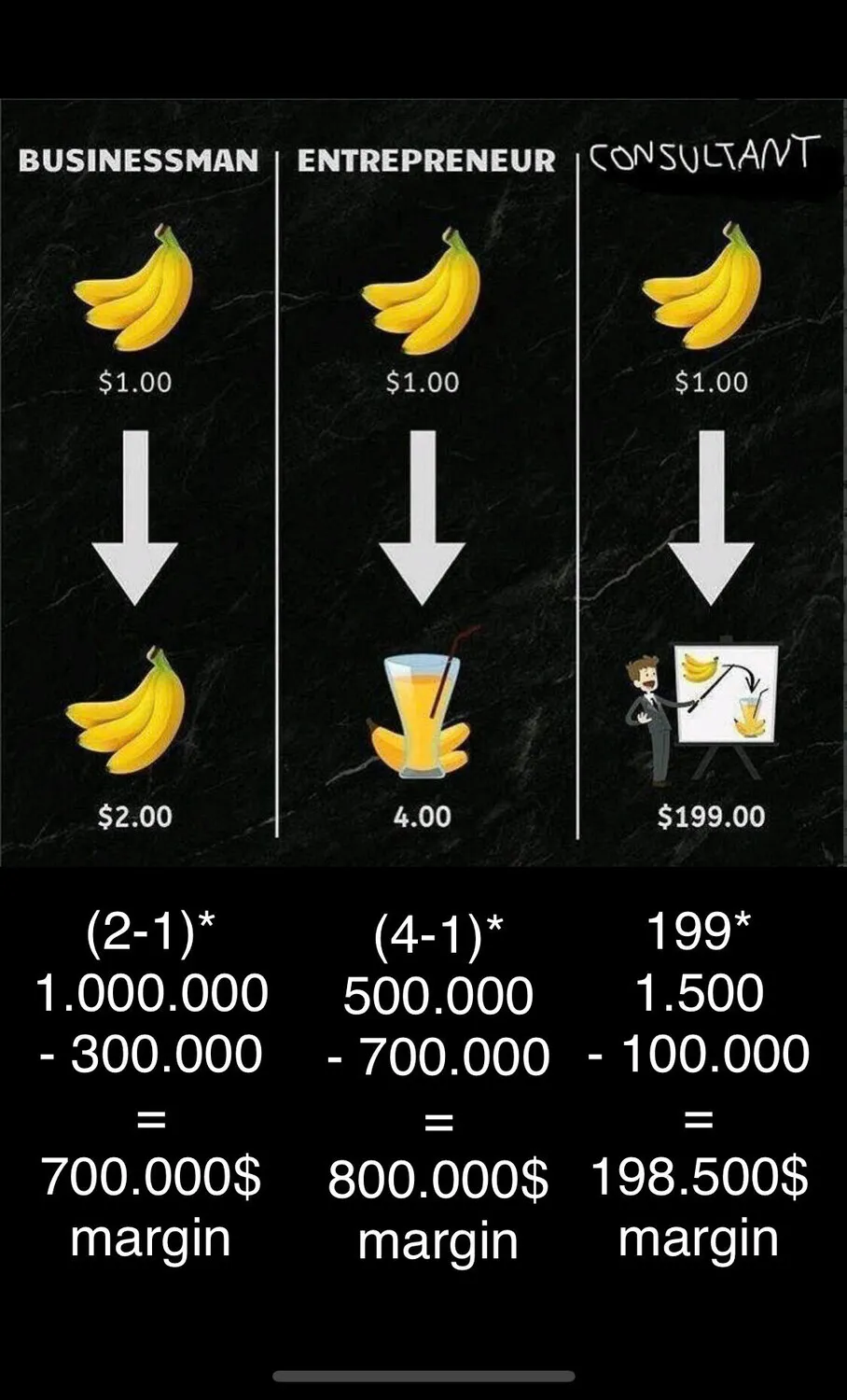
Though the consultant is making more money, he may have higher costs than the others resulting in a lower net return (Profit).
Conclusion
Do not arrive at Conclusions without paying attention!
First published on LinkedIn.