I won an AFCA case against an insurer for $6,000. I didn’t win because AI wrote better letters; I won because AI dramatically reduced the cost of analysing information.
A few weeks ago, AFCA issued a determination in my favour following a dispute with Budget Direct. The outcome was $6,000. Yet, that wasn’t the most interesting part. The dispute lasted eight months. Looking back, the most significant factor was not the merits of the case. It was the cost of analysis.
The economics of analysis
Historically, large organisations held an advantage in situations like mine, where the success depended on access to information and expert knowledge (e.g., lawyers, case officers) to analyse it. The advantage was never simply knowing more. It was being able to process information more effectively. For example, reading 40-50-page documents, deciphering legal language and regulations, testing competing arguments, finding contradictions, and assessing what mattered, etc.
In contrast, an average person walks into the process with limited knowledge, limited time and limited resources. A case like this becomes uneconomic long before it becomes unwinnable. The limiting factor is not necessarily merit. It is often the effort required to continue reviewing evidence, testing arguments and responding to new information.
The Budget Direct dispute
After an accident, my vehicle was incorrectly recorded on the Written-Off Vehicles Register. I challenged the decision with VicRoads, yet VicRoads re-confirmed their decision. Believing there was no alternative, I sold the vehicle for salvage value. Only after the sale did the insurer acknowledge the WOVR listing had been made in error. It was 6 weeks after the initial letter and a week after the deadline that VicRoads gave me before cancellation of my registration.
After knowing that I incurred a loss due to the insurer’s error, I raised an IDR (Internal Dispute Resolution) asking them to reimburse my loss. However, the insurer sent me in circles, and eventually rejected my request 5 hours before the 1-month mandatory deadline, with a long document with legal terms, evidence, screenshots, transcripts etc.
I followed the complaint process with the Australian Financial Complaints Authority (AFCA). After 5 months, to my surprise, I was only offered $2,550 by the AFCA case officer. I knew I was in a strong legal position because, with AI, I had already analysed all the facts. I knew I was right. I rejected the “Preliminary Assessment” and decided to follow through to the end. That took another 3 months, and an adjudicator granted me almost the full value that I was claiming for.
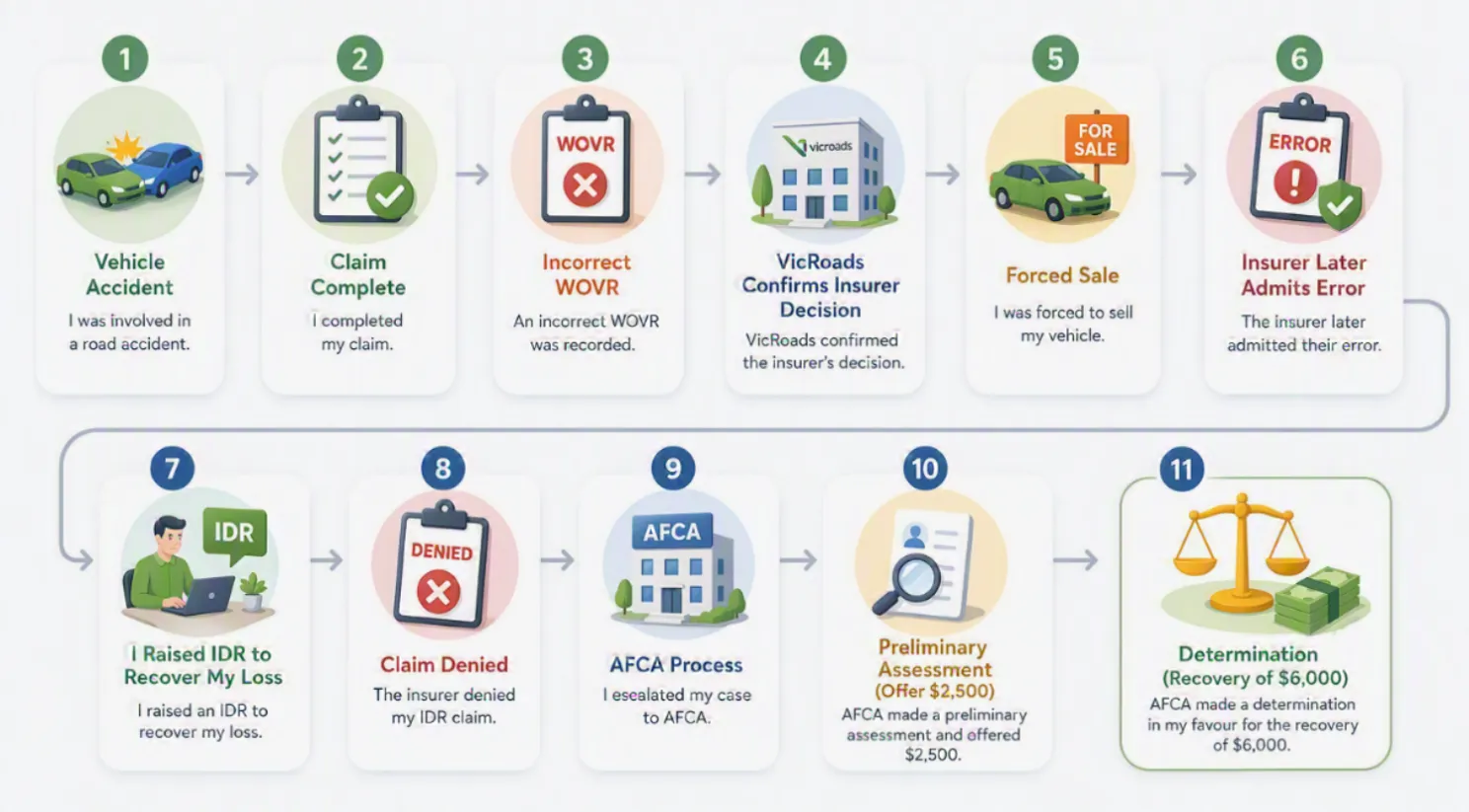
The Process Flow
This wasn’t an insurance dispute. This was an information-processing capability problem. But I knew that with my expertise in AI, I could influence the information asymmetry and the economics of pursuing in my favour. I reframed this whole process as a learning exercise. My target was not recovery but learning the process and proving my point.
Using AI as an analysis system
Looking back, I wasn’t using individual AI techniques. I had unknowingly built a repeatable analysis pipeline. First, I gathered and compressed information. Then, I analysed it and stress-tested the reasoning. Finally, I optimised how the conclusions were communicated. The individual tools mattered less than the workflow.
1. Collecting and Compressing Information
Across submissions, correspondence, evidence packs, regulatory documents and personal notes, the dispute generated more than 220 pages of material. When I consider my preparation notes, contracts etc., it is even larger. One of the largest insurer submissions exceeded forty pages. The challenge was not reading the document, it was understanding what was missing. Extracting what are the most important artifacts buried in those documents that support my claim. Examples:
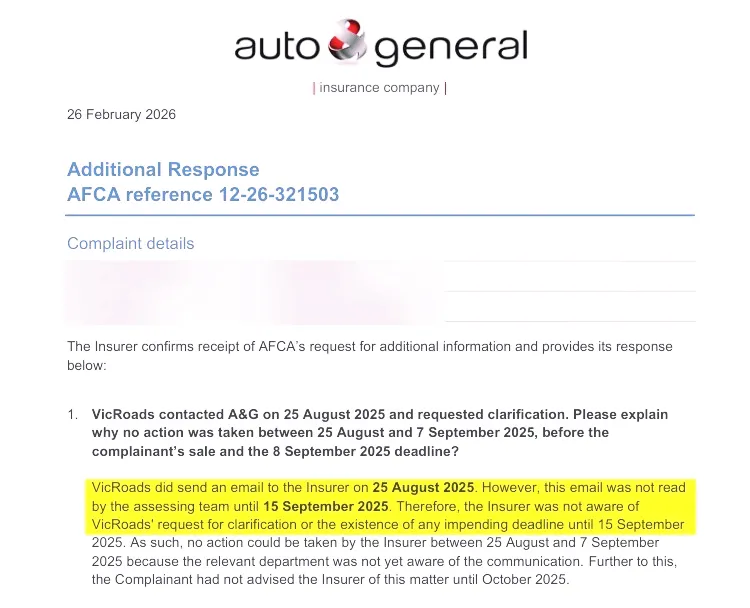
- Insurer not being informed: This ended up being one of the most important discoveries in the entire case. Originally, the insurer’s position was that I had not contacted them directly about the VicRoads decision, and therefore they did not have the opportunity to correct the WOVR listing before I sold the vehicle and hence they are not liable. Insurer: “Crucially, the Complainant did not notify A&G of the WOVR issue, the deadline, or their intention to sell at any point before A&G’s awareness on 15 September.” However, during a forensic review of their own submissions, AI identified a discrepancy on the date that VicRoads informed the insurer. This proved that the insurer had been notified well before my decision to sell the vehicle. The evidence was sitting inside the insurer’s own materials. This fundamentally changed the discussion. These were buried inside 2 different pages in two different documents in an 8 page, over 100 page submission.
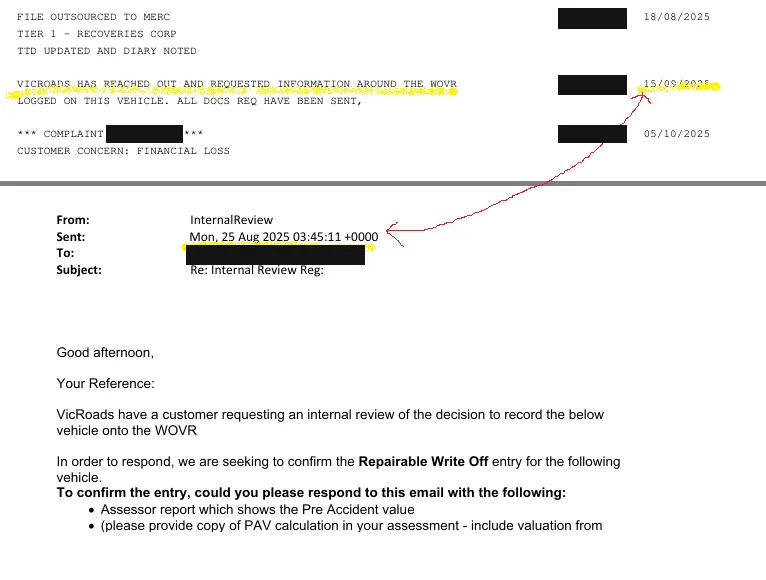
- Once highlighted, the argument shifted to “VicRoads informed us. But we didn’t read it. Therefore, we are not liable.” AI helped me draft a very strong legal rebuttal for this argument. AFCA ultimately rejected this reasoning. Looking back, this was probably the clearest example of the value of AI-assisted analysis. The key evidence already existed. The insurer had provided it. The challenge was finding it within hundreds of pages of material and understanding its significance.
- Car Valuation: I found that the insurer’s own valuation exceeded the market valuation I used when lodging my claim, which helped me prove that my claim is reasonable. This information, too, was hidden inside the long documents that the insurer has submitted. The word “Forensic” did a lot of work in this case.
- Extracting Timelines and establishing causation: A large part of my exercise was to claim the causality of the insurer’s action into realisation of my loss. Given that there are a lot of events, spanning over a period of multiple months, constructing a clear timeline of events from the accident till the end and establishing causality was something that AI was great at.
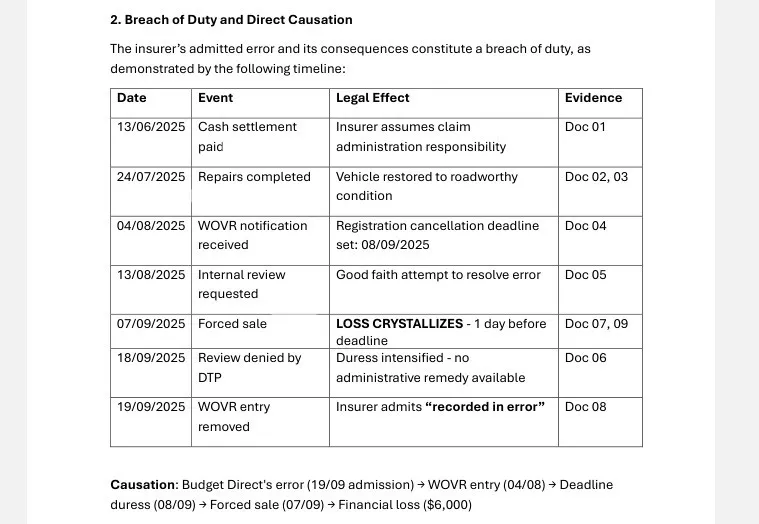
Timeline and Causation
2. Analyse and Challenge
Access to expertise
Knowing that I have access to expert knowledge in the field through the entire process was a big motivator for me to pursue this process. Historically, I would have needed a lawyer, insurance specialist or AFCA expert. But now, I could count on AI. This was a big mental relief during the process. AI helped me dismantle many legal arguments that the insurer raised.
For example, one of the insurer’s central arguments was that my losses were consequential losses and therefore excluded under the policy. AI was particularly useful here, as it allowed me to test the argument from multiple perspectives. The more I analysed the issue, the more it appeared the loss flowed directly from the insurer’s admitted administrative error rather than indirectly from the original claim. AFCA ultimately came to a similar conclusion.

Advanced Prompting Techniques
Prompting was a key part of the whole process. I knew that the quality of the question mattered more than the quality of the answer.
I got a cheaper AI model to clarify my intent/goal. I used techniques such as getting AI to interview me until it thinks that I am clear about my goal. Then I fed the reframed goal into a cheaper model to design prompts. Subsequently, I would port that prompt into specialised models to execute the prompt. This separated problem framing and prompt design from reasoning and reduced experimentation costs.
I used adversarial prompting to stress-test both my arguments and underlying assumptions. For this I used techniques such as playoff-prompting and adversarial analysis. I would ask one AI to steelman the Insurer’s argument, then use another to challenge those points using evidence acceptable in an AFCA dispute. For every argument, I understood the failure modes.
Over time, the system became increasingly better at the task. Both AI and I got better at knowing and interacting with each other. If I came across a reusable process, I got AI to create a workflow prompt. For instance, a simple timeline prompt evolved into a forensic workflow: create timeline → identify gaps → perform temporal fidelity analysis → identify contradictions → test causation. Over eight months the prompting system continuously improved. Better prompts produced better analysis, which revealed better questions, which in turn led to better prompts.
Cross-model Review
Different AI models fail in different ways. For instance, while Claude excels at writing, its first pass missed the most critical point supporting my position: the insurer had been informed by the regulator prior to my sale. Conversely, Gemini successfully identified this fact.
On several occasions, one model agreed with the insurer’s interpretation while another identified weaknesses in the causation logic. So I got multiple models to review each other’s output, i.e. Output from Model A -> critique in Model B -> gaps identified -> fed back to Model A to improve. Rather than treating disagreement as a problem, I treated it as part of the review process. The goal was not consensus. The goal was to identify blind spots.
Another use case for cross-model workflows is input compression. Feeding long, raw documents directly into expensive models would have wasted my token allowance. Instead, I used cheaper models to compress the inputs (Eg. Documents) into a high-fidelity artifact, then fed that artifact into a stronger reasoning model.
3. Communicate: Audience calibration
Another observation emerged during the dispute. AI frequently produced arguments that resembled legal submissions. They were technically strong, but often unnecessarily complex. This became one of the clearest examples of where human judgement remained essential. The AI helped analyse the issue. The human decided how to communicate it.
For instance, AI proposed full-blown legal letters for my submissions. Legally they were very strong and had all the things that a case of evidence should have. However, AFCA submission guidelines state that AFCA rewards clarity more than sophistication. Evidence, logic and plain language consistently proved more effective than highly formal legal language. So I had to iteratively simplify AI’s responses.
Also, I understood that the case officers are not lawyers and they are going through multiple cases like this. Therefore, I optimised my submissions for readability. Added specific quotations and references to other documents. Included tables. My objective was to make the case officer’s life easy. Furthermore, some of the proposed submissions of AI were over-assertive. I had to iteratively optimise to get the right balance.
4. Improve Economics: Session and Context Management
There’s a cost most people don’t account for in long disputes. AI context decay. As sessions grow longer, earlier context degrades. The analysis gets worse precisely when the stakes get higher. Managing that was as important as the prompting itself.
I used techniques like Context Compression, Progressive Abstraction, and Goal Anchoring to keep AI aligned with my goal. I frequently created session checkpoints, thread index and nested shards and stored them in Obsidian to keep myself updated. I started every stage of the dispute in a different session to keep each session’s length manageable. In addition to keeping AI focused, this reduced my token cost as well.
When I transitioned to new chats or to a different AI (Eg., Claude to Gemini), I had to ensure that the previous context is transferred accurately and sufficiently. I used my own compression and handoff prompts to ensure this.
To ensure I capture the full context and feed into AI, all major stages and discussions were documented, decisions were recorded. This repository became the system of record. This proved almost as important as the AI itself. Analysis quality depends heavily on context quality. I treated the dispute as a knowledge management exercise, folder structure, file naming, and session records maintained to the same standard I’d apply to a commercial project.
My Contribution?
Looking back, AI didn’t win my case. My persistence did. After months of gathering evidence, writing submissions and working through the AFCA process, the case officer recommended $2,500. That’s the moment most people stop. It feels like a verdict. I rejected it and requested adjudication. Three months later, an adjudicator awarded me $5,944.
I continuously optimised the workflow. I knew how to use AI. I had my optimised prompt vault. But I didn’t stop there. I developed specific workflows that are tailor-made to this specific situation and was very disciplined to send all information through that pipeline. I studied the words that AI is optimised for. Fidelity, inferential chains, analyse vs evaluate, failure modes, steel manning, gotchas, forensically, etc. One word did the work of many paragraphs.
AI wasn’t replacing my expertise. It was amplifying my ability to search, compare and reason across hundreds of pages without fatigue.
What changed?
This wasn’t about an insurance dispute. This was about information processing economics. Every contract, procurement tender, project dispute, compliance, governance, risk, negotiation, board papers, and due diligence exercise is no different. The party that can process information faster and more economically has an edge. AI is levelling the playing field. Today, the competitive advantage increasingly becomes integrating AI with workflow design, context quality, human judgement and decision architecture.
The most interesting thing about this dispute is that none of the information was hidden. The evidence existed. The regulations existed. The insurer’s submissions existed. The challenge was processing them. Historically, that required large amounts of time, expertise and money. A significant portion of professional advantage came from the ability to process information efficiently. AI doesn’t eliminate those activities, it changes their economics.
Note: This determination is publicly accessible under AFCA’s publication guidelines. Brand names are used factually and in that context only.
First published on LinkedIn.