A few months ago, I wrote a letter to my mum, the first since 1995. Below is an excerpt of that. I wrote it in my native language. I’ve included the translation below.
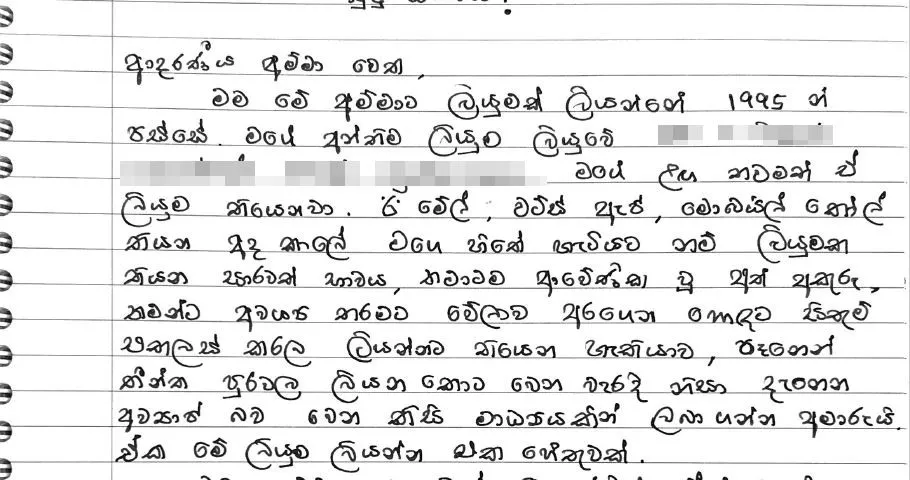
Dear Mum, I am writing this letter to you, after the last one I wrote in 1995. I still have that original letter. Today, communication is dominated by email, WhatsApp, and mobile messaging. However, in my view, all of these media have failed to match the richness of a handwritten letter… the quality of the content, when I take my time to collect my thoughts before I put them on paper… the authenticity that it gets from the mistakes and corrections that I make when I write with my pen filled with ink. It is one of the reasons why I decided to write this letter.
The happiness I felt after completing the letter was something I hadn’t experienced when sending an email or a WhatsApp message. The satisfying soreness I felt from writing continuously for a while… the fulfilment that came from knowing I had put effort into collecting my thoughts, organising them, and putting them into words with my own hand. It was special. I am sure my mum felt a similar, special feeling, when she saw her son’s handwriting, that she taught me, after so many years… when she saw that I have made a real effort to write something to her without using autocorrect or AI… when she saw the quirks and little mistakes of mine, some of which she might have asked me to correct when I was learning from her.
This made me realise that, in a world driven towards achieving perfection supported by increasingly human-mimicking technology, it was the imperfections that gave me joy.
This prompted me to write this article, without AI, because I thought it was a very timely topic. AI is getting better by the day. The day that Artificial General Intelligence, where a machine can mimic human intelligence, is getting closer. There is mass adoption of AI and other AI-related technologies. Very soon, many of our interactions with the external world will happen either through, using or aided by AI. With that, everything will become increasingly perfect.
The majority of emails you receive will be crafted by AI. They will be free from any spelling or grammar mistakes… yet without any personality or emotions. Most of the songs will be AI-generated. They will have the perfect tune and amazing voices… yet without any subtle “off-tune notes”, without the raw personality that it gets through the singer’s story and the struggle. Most of the art will be AI-generated. Beautiful and perfect… yet without the authenticity that it gets with that one imperfect brush stroke. Every article will be well-structured, without mistakes, well-balanced, content-rich, and research-rich… yet will not have the opinion of a human.
In a world where everything is perfect, human imperfections will not just become desirable. But it will command a premium.
AI is about scale. But you cannot scale “special”. People will be prepared to pay a premium for products and services by real humans. People will desire human imperfections. People will start searching for “realness”. The realness that enables them to connect. The realness that conveys the empathy or authenticity.
AI is about the destination. However, the value in human life is in the journey. After we have our basic needs, we find our purpose is in the human struggle. The value is not only in the output, but also in the input. As humans, we improve because of the struggle.
AI is about convenience. However, we develop our skills through effort, struggle and mistakes. Before mobile phones, we could remember addresses and phone numbers. Before calculators, we were better at mental math. These skills got weaker because we gave up the struggle. Now, we are not great at them because we outsourced the struggle. We didn’t have the need to go through the inconvenience of remembering or calculating. And now if you apply the same logic to outsourcing our main differentiators as humans, our cognitive functions & consciousness, our ability to connect with another human, our ability to resolve conflict, our ability to empathise, it doesn’t take much effort to extrapolate the potential consequences. Already there are numerous reputed publications that talk about the deterioration of cognitive skills due to over-reliance on AI for these key tasks. There is also a term called “AI-induced cognitive atrophy”. Our brain has a key principle: “Use it or Lose it”.
AI is about perfection. However, the beauty is in the uniqueness created by the imperfections. The Japanese concept “Wabi Sabi” clearly articulates this. This philosophy is about the appreciation of beauty that is “imperfect, impermanent, and incomplete”.
At the same time, I don’t believe it’s all doom and gloom. AI has a multitude of functional advantages for us. I am not an expert in AI or Anthropology. However, listening to people who know about both of these fields and critically thinking about them prompted me to be mindful about getting ready to live with AI. I will encourage my kids to…
- Appreciate and celebrate human imperfections. The world is going to have less of it.
- Re-define the relationship with AI as a tool to improve the outcome of our effort, but not a replacement for it. Use it to validate rather than generate. Embrace the struggle to realise the benefits of learning and improvement that come with it.
- Invest in key human skills that AI cannot replicate perfectly. Empathy, conflict resolution, leading other humans, listening, love and friendship. These skills are the very cornerstone of our evolution as the smartest species on earth, yet. In the very unlikely situation where AI becomes a threat to our existence, without these skills, we will not stand a chance.
- Be intentional about the technology use. Use technology, instead of getting used by it.
- Be a lifelong learner. Research meta-learning, i.e. learning how to learn.
- And most importantly, to send me a handwritten letter every once in a while.
In a world that is becoming perfect, the most human quality of ours is achieving greatness, struggling through our imperfections.
First published on LinkedIn.