A few days ago, OpenAI launched its latest model, GPT-6 Astra. The benchmark results were impressive. Whilst reading about its capabilities, one example affected me more than any benchmark.
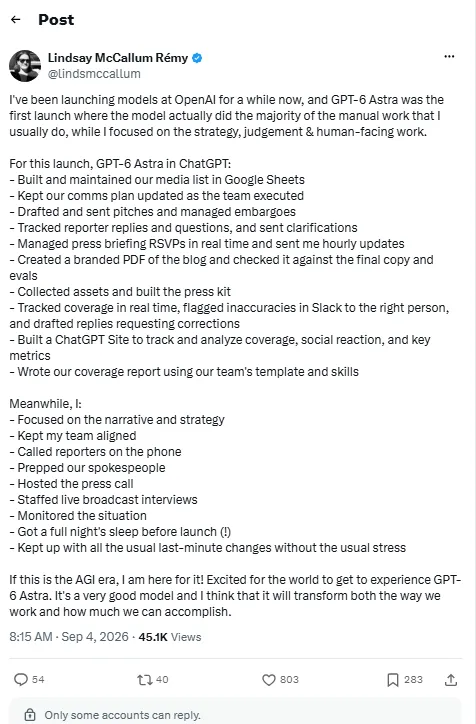
An OpenAI communications manager’s tweet about how she used Astra to complete the majority of the manual work involved in launching a campaign. The tweet suggested that the communications manager retained responsibility for strategy, people and judgement whilst AI handled much of the execution and coordination around that work.
That example immediately took me back to an earlier period in my career.
I have lived the workflow that AI is beginning to compress
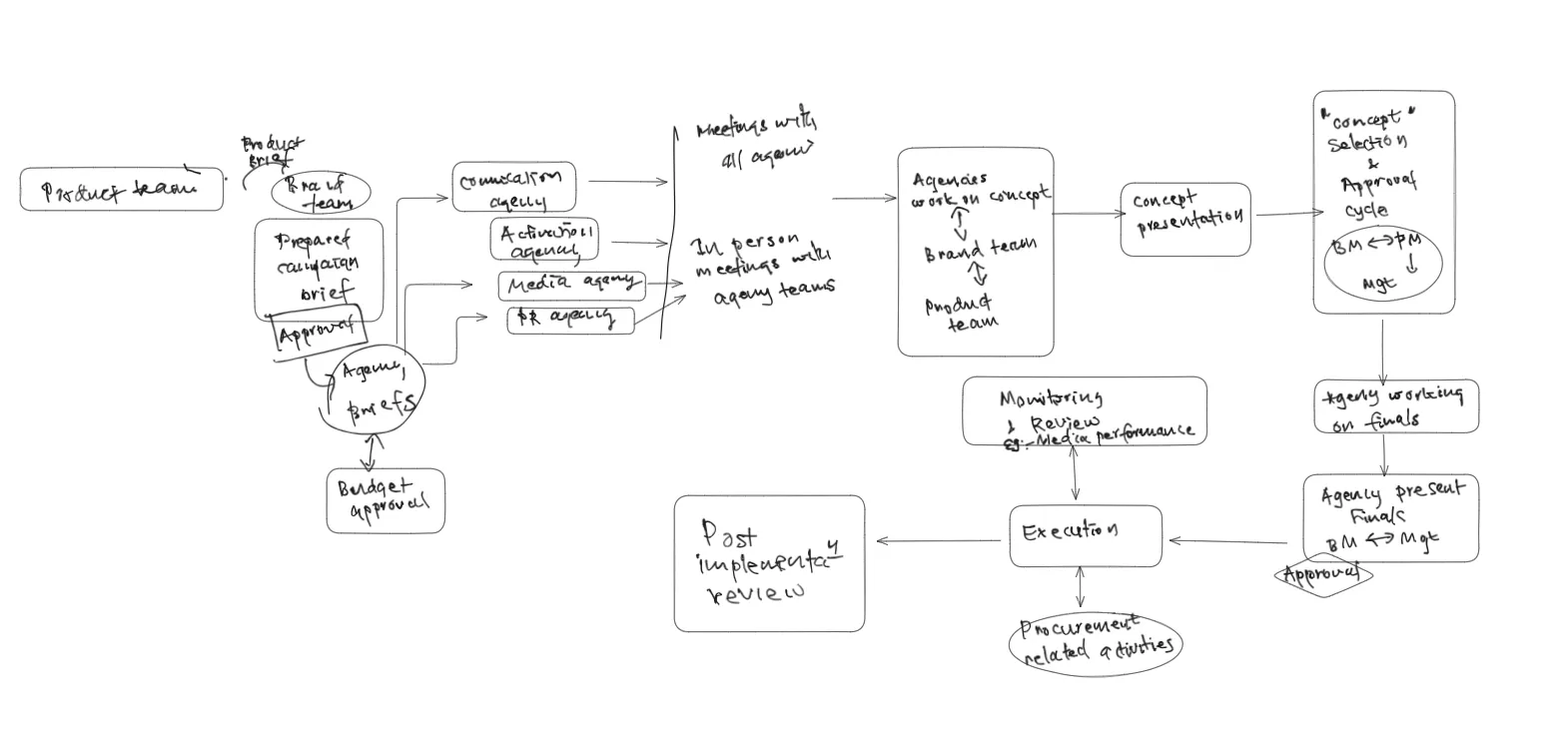
For a period, I worked as Senior Brand Manager for the mobile business unit of a leading telecommunications company. Most of the campaigns I managed were large product-marketing launches. A typical campaign moved through product teams, brand teams, internal management and several specialist agencies covering creative, media, digital, public relations and events. As Senior Brand Manager, I coordinated these contributors while making the decisions and judgement calls needed to keep the campaign moving.
Every hand-off created interpretation, coordination and rework. Briefs became proposals. Proposals went through presentations, feedback, revisions and multiple levels of approval. Information also lost clarity as it moved between people. Some campaigns passed through 20 to 30 revision cycles before reaching the market. Depending on its scale, the full cycle could span over a few months and involve many people, divisions and external organisations.
Go-to-market cycle
The process was expensive, difficult and emotionally taxing. Competitive timing mattered. Media targets mattered. On-time-in-full delivery mattered. Teams frequently worked late at night, over weekends and on public holidays.
I remember, once I worked through a personal milestone, which fell on a public holiday, to meet an important campaign deadline. That was the ask of the job.
Astra did not replace the communications manager
It is important to note that GPT-6 did not manage the entire marketing campaign independently. It did not replace the communications manager. The human retained the narrative, strategy, relationships, alignment and accountability. The model absorbed much of the manual execution and coordination surrounding that judgement.
The distinction is that AI does not need to replace the campaign leader to transform campaign economics. It only needs to absorb enough execution and coordination work to reduce hand-offs, agency hours, revision time, elapsed time and organisational friction.
The old model was:
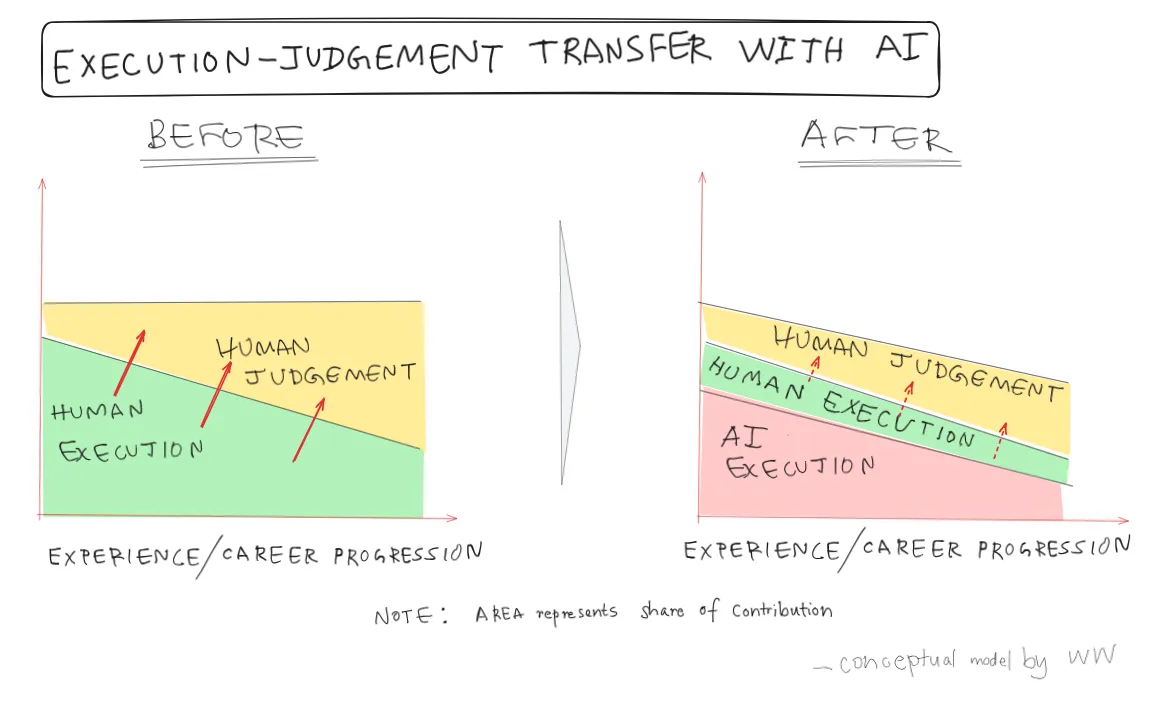
Human judgement + human execution
The emerging model looks more like this:
Human judgement + AI execution
Over time, with AI models gaining more capability, the boundary may move again:
Human accountability + AI-supported judgement + AI execution
The real shift is from task automation to workflow compression
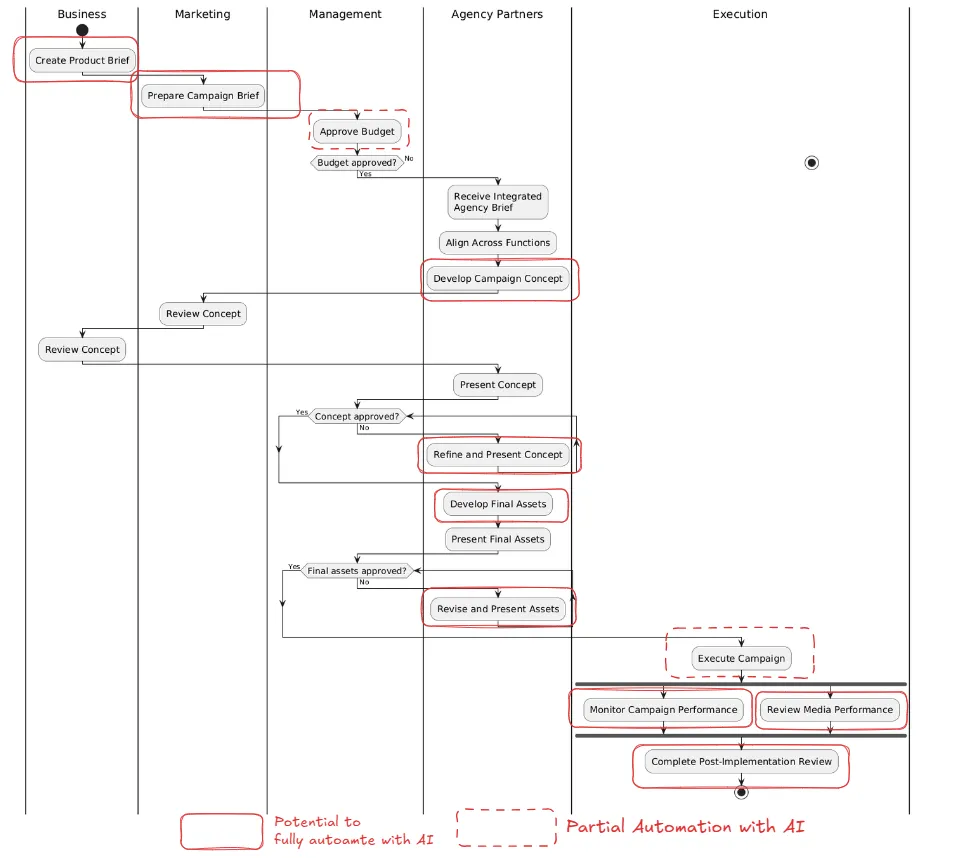
In the traditional campaign development process, AI can already contribute to product/campaign/agency briefs, audience research, messaging & creative concepts/assets, reporting and performance analysis. Agentic AI can also update plans, coordinate information, track responses, prepare documents and escalate exceptions.
Task automation reduces manual activity. But, workflow compression removes hand-offs and shortens iteration cycles. It also requires fewer people to deliver the same output.
The outcome will not be identical everywhere. Some roles will shift towards judgement-intensive work. Some roles will disappear. The direction is increasingly clear. AI creates the potential for faster execution, greater scale and materially lower coordination costs.
High level abstraction to illustrate Go-to-market cycle
Lower cost and faster execution are only the first-order effects.
In the Go-To-Market example, with AI, campaign execution cycles become faster. Agency and production costs fall. Coordination overhead reduces. Generating alternatives and testing become almost free and instant. Professionals spend less time on laborious tasks maintaining Excel sheets, preparing status updates and sending emails etc.
Removing unnecessary overwork is a positive outcome. However, in my experience not having that grunt work removes an important part of the equation.
Every revision was frustrating, but every revision was also a learning cycle. By developing briefs, evaluating imperfect concepts, negotiating with stakeholders, responding to competitive pressure and observing campaign results, we gradually learned what worked. We developed pattern recognition. We learned which concerns were material, which compromises were acceptable and which apparently small decisions could damage the campaign. Mistakes carried consequences. Direct feedback made the lessons difficult to forget.
The gruelling process did not merely produce campaign assets. It also produced professional judgement.
The judgement catch-22
The common view of AI-enabled work is that
AI will perform the repetitive work. Humans will retain strategy, judgement and accountability.
That may be the right operating principle today. But it creates a catch-22. People usually develop judgement by performing the boring repetitive work, making decisions, seeing failures, receiving feedback and gradually taking on greater responsibility. The development path is not linear. It often looks like:
Execution → repetition → feedback → pattern recognition → tacit knowledge → judgement
If AI removes most of the execution, most of the mistakes, future professionals may receive fewer repetitions, fewer direct feedback loops and less exposure to the exceptions through which expertise develops.
Conceptual model based on professional experience
Companies will then have to ask people to supervise work they have never performed and exercise judgement they have had fewer opportunities to build. In my view this may become one of the hardest organisational problems of the AI era.
I am not suggesting that we should preserve inefficient processes or unnecessary suffering. We should not. The question is whether we can remove the burden without accidentally removing the learning.
I do not have a complete answer. What is clear to me is that developing human judgement must become a central design requirement for AI-enabled knowledge work. However, the problem is more complex than proposing new training methods. The real question is whether those methods can reproduce the tacit knowledge, consequences and accountability through which professional judgement develops.
The question leaders should now ask
GPT-6 did not convince me that humans have become irrelevant. It showed something more immediate and commercially significant. Today’s AI is capable enough to compress workflows, reshape teams and change the economics of knowledge work.
The question is already changing from
What tasks can AI automate?
to
If we redesigned the entire workflow to be AI-first, where would human judgement create the most value?
However, the even bigger existential question is,
Judgement becomes the most important human contribution. But if AI does the tasks that develop that judgement, how will the next generation acquire it?
First published on LinkedIn.