Unit Economics (UE) is more than a financial concept. It’s a tool that enhances your understanding of profitability, pricing, and portfolio decisions. While traditional P&Ls indicate whether a business is profitable, UE explains “why” and, more importantly, “how” to improve it.
“Unit Economics” refers to the economics (i.e. the profitability) of a single unit. Depending on the application, the unit could be a single unit of product/service or a customer. This concept helps businesses understand their long-term sustainability and profitability by determining if each unit or transaction is enhancing the bottom line of the company.
I was introduced to this concept early in my career as a junior commercial analyst at a telecommunications firm. The organisation embedded UE into its core planning and decision-making. Many of my analyses and recommendations were either backed or enhanced by unit-level insights—a mindset I’ve carried through roles across telecom, fintech, ICT and FMCG sectors.
In this article, I will explain the importance of UE, along with examples from my own experience where I have applied this concept.
Applications of Unit Economics
1. Launching New Products or Businesses
When launching new products, understanding UE ensures that every unit sold contributes positively to the company’s profitability. Without this clarity, companies risk scaling a product that loses money with every sale—a costly and often unsustainable approach.
Also, UE enables us to understand the breakeven point and validate its viability with respect to the market opportunity. For instance, if the breakeven point of the product is significantly higher than the market opportunity, the business will fail.
E.g. (New Business): I once worked on developing a new business model and business plan for a newly acquired fintech company. UE analysis (Figure 1) revealed that high NPL rates and call centre costs were significantly eroding value. Consequently, we decided to offer first-level customer support and customer onboarding, including KYC (Know Your Customer) requirements, exclusively through digital channels. We also decided to invest in reducing the NPL ratio, which led us to prioritise developing an AI-driven NPL prediction model based on telecom user behaviour.
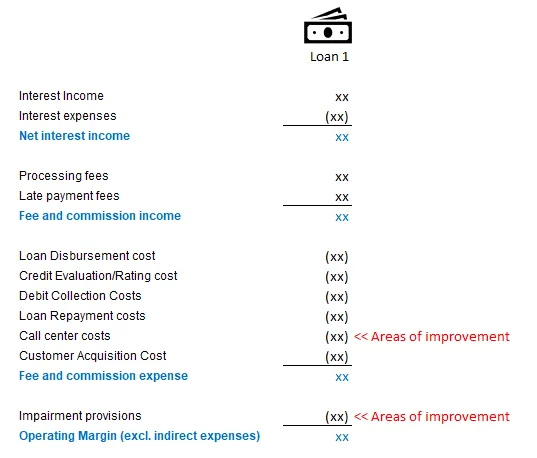
Figure 1: Product P&L for a Micro Loan product
E.g. (New Product Launch): As a Commercial Analyst in the B2B division of an FMCG company, I prepared the product P&Ls when new products (NPD) were introduced. This involved understanding the product cost structure and customer acquisition costs, and ensuring the selling price is set to generate a suitable profit margin. Where relevant, these were supplemented with a sensitivity analysis to understand any cannibalisation of existing SKUs.
2. Rationalising the Product Portfolio
By analysing the profitability of each product on a unit basis, business managers can make informed decisions about product viability. This may involve investing in a product, discontinuing it, or outsourcing to improve profitability. Moreover, companies might decide to exit specific segments if a product’s cost structure prevents them from competing profitably at a reasonable price, or they might enter new segments if they appear to be lucrative.
E.g. (Portfolio Rationalisation): In my role as a commercial analyst within that B2B Division, I regularly evaluated product UE (Figure 2) to assist management with portfolio decisions. Recommendations for each product’s future were made according to their respective margins. For those with low margins, we analyse the underlying causes and take corrective actions. These actions may involve changing suppliers, investigating new Bill of Materials (BOMs) with alternative formulations, and modifying product pricing. Later on, with the adoption of Power BI, automated dashboards were introduced to get the near-real-time product profitability.
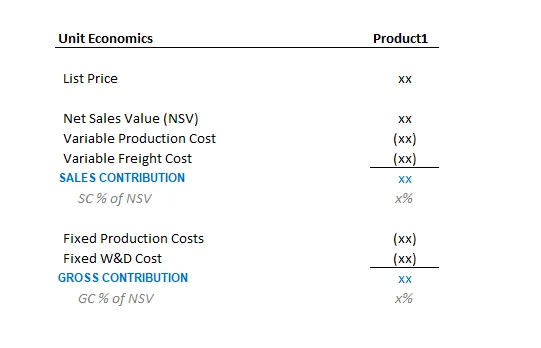
Figure 2: Sample Gross Contribution Calculation for a Product
3. Supporting Capital Investment Decisions
Certain business decisions require capital investment, such as buying a new machine or investing in new IT infrastructure. When deciding whether the investment is financially viable, you must ensure that it will generate a higher IRR than the WACC or will pay back within a shorter period than the organisation’s benchmark. To achieve this, the volume of the product that can be practically sold at a competitive price point should be able to generate a Contribution Margin (Sales Contribution) that exceeds the investment.
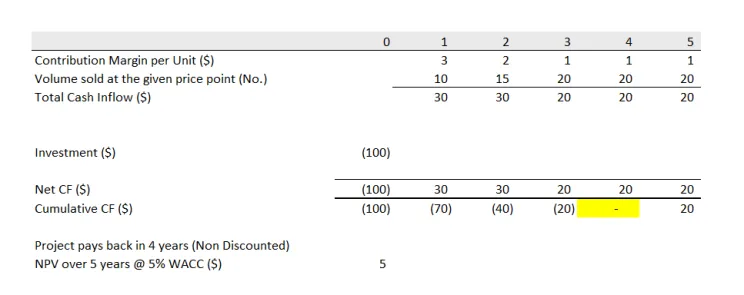
Figure 3: Investment Appraisal Example
4. Understanding Customer Lifetime Value (CLV)
UE helps a business to understand the CLV (Customer Lifetime Value) and CAC (Customer Acquisition Cost). The CLV:CAC ratio provides a yardstick for how much the company can spend on customer acquisition. Additionally, it helps identify the most profitable customer segments that the company or product should target.
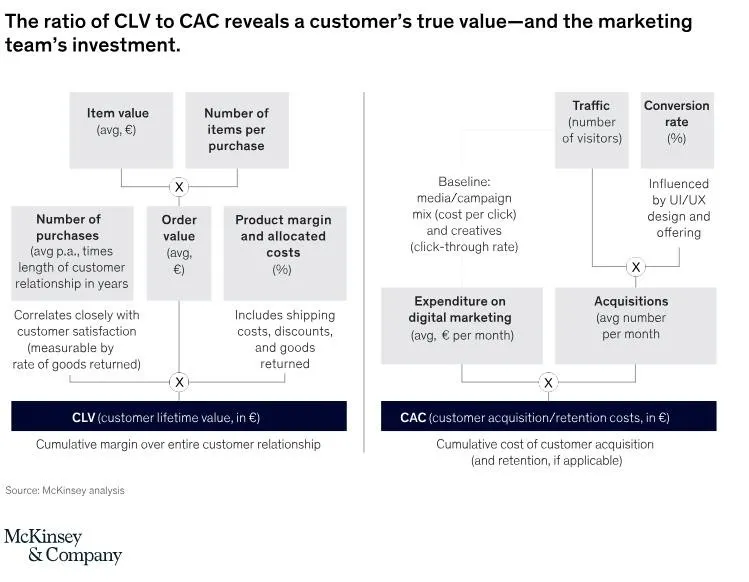
Figure 4: CLV and CAC
E.g. (CLV and CAC): When I was on the corporate planning team of an ICT operator, I oversaw the Broadband Division’s planning and strategy function. Our team prepared and reviewed many product launch proposals. Since it is a long-term customer contract, the concept of CLV was very relevant. By using UE, we decided the maximum freebies (free data, connection fee waivers), sales commissions, and CAC that the product could bear while remaining profitable.
5. Product Pricing
When a product doesn’t have direct substitutes or reference points, customer willingness-to-pay studies, the cost-plus pricing strategy becomes one of the most viable options. To implement this, the business should understand the unit cost structure of the product. It’s especially valid and widely used in B2B, industrial, SaaS, and specialty product segments where innovation often precedes competition.
E.g. (Product Pricing): As a Senior Commercial Analyst in the ICT industry, I managed pricing for enterprise solutions. These products are highly customised based on the customer’s requirements and lack market benchmarks. Some solutions involved providing costly hardware at no charge. To ensure profitability, we calculated the full unit cost and used customer LTV to determine sustainable subscription pricing.
6. Enhancing Operational Efficiency
UE offers a way to analyse the product cost across a value chain. Also, it enables the business to compare the costs in different components of the value chain through multiple lenses, such as by product, by customer, by geography, etc. This allows teams to identify inefficiencies and make targeted improvements. By breaking down operations into measurable components—such as cost per unit produced, fulfilled, or delivered—organisations can uncover hidden cost drivers.
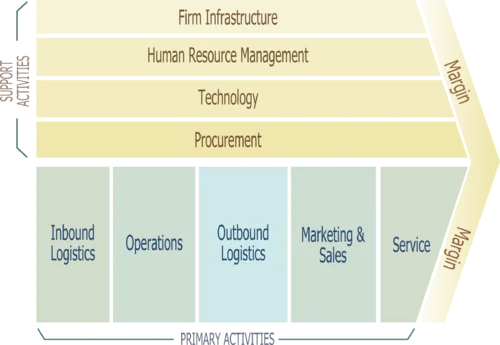
Figure 5: Michael Porter’s value chain
E.g. (Operational Efficiency): During my time as a finance business partner for supply chain, we analysed and reported on unit costs within the supply chain. This encompassed assessing the cost per unit across various activities within the Supply Chain. Evaluating unit costs enabled us to benchmark against industry standards and pinpoint potential improvements. Additionally, using consistent units allowed us to compare Costs to serve across different geographies, customers, products, and so on.
7. Product Costing and Inventory Valuation
Identifying a product cost at a unit level becomes critical in Standard Costing environments. The standard cost is used in establishing the Cost of Goods Sold (COGS) and the inventory value. Consequently, the precision of product costs directly influences the accuracy of the company’s short-term plans and forecasts. In such settings, unit costs are regularly updated to accurately reflect costs in the financial statements, a process typically referred to as a “Cost Run.”
E.g. (Product Costing): In my role as an Operations Controller in FMCG, I led the costing of externally purchased goods. This required quarterly ‘cost runs’—calculations of unit costs based on supplier pricing, shipping lanes, container utilisation, and transfer pricing. These unit costs directly impacted COGS and inventory valuation, highlighting the strategic weight of accurate UE.
Conclusion
From the above examples, it is clearly evident that Unit Economics plays a pivotal role in management decision-making in any business, and any analyst/business partner should be thorough with the concepts of unit economics.
In summary, UE is a business necessity. Whether you’re launching a new product, managing a diverse portfolio, or planning capital investment, understanding profitability at the unit level is essential. If you want to make sharper, data-driven decisions rooted in financial fundamentals, start with UE.
Sources:
McKinsey & Company. Customer lifetime value: The customer compass. Retrieved from McKinsey Digital
First published on LinkedIn.